
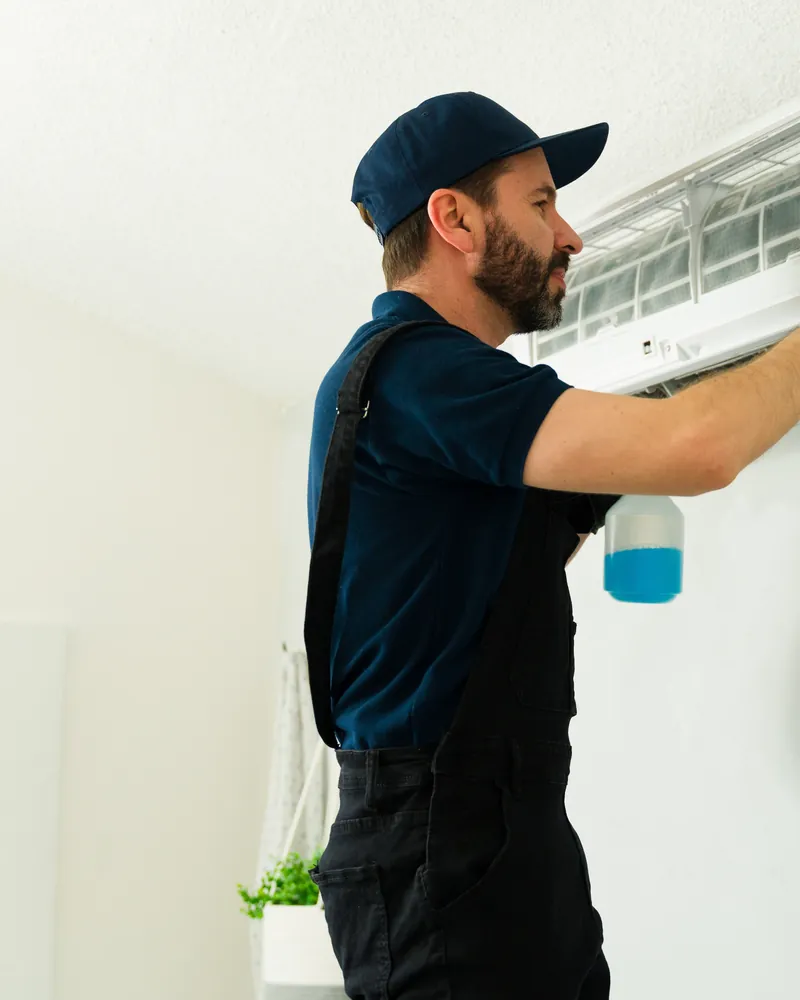
Ductless Mini-Split Installation in Denver, CO
Cool a Denver Bungalow Without Tearing Into Plaster
Ductless mini-split installation for Denver's older homes: heat and cool one room through a single small wall opening.
5.0 · 129+ Google reviews Licensed & insured Family owned
Mini-Split HVAC for Denver Homes
A Cool Upstairs Room in Your Older Denver Home
★★★★★
Get Your Denver Quote in Writing
Equipment, line set, electrical circuit, and permit, itemized before any work starts.
If your Denver house was built before 1960, you've probably lived this already. The upstairs bedroom stays hot long after the sun goes down, and nobody wants to open a plaster ceiling just to run ductwork. Roughly one in three Denver homes predates 1960, and plenty of them came with radiators or no cooling at all.
A ductless mini-split cools that room without touching the rest of the house. One small hole through the wall carries the line set to the outdoor unit, and your plaster, brick and trim stay right where they are. Denver gets more than 300 days of sun a year, so west-facing rooms, sunrooms and top floors heat up fast, even though the air is dry.
Winter is the other half. January nights in Denver average around 16°F, so the number worth asking about is the unit's rated heating output at low temperatures. A cold-climate-rated system can heat that same room when it matters. If you already have a working boiler or furnace, the mini-split can simply take over the one room that never got comfortable.
What you end up with is a room with its own thermostat, no demolition, and a house that still looks like the one you bought.
Google Reviews
Neighbors Near Denver Rate Us 5 Stars
Local Mini-Split Installer in Denver
A Crew Based on Both Sides of Denver
Comfy Castle Heating and Air LLC is a Colorado owned and operated company led by Nathan Hernandez, who most customers just call Nate. We started in October 2023, so we won't pretend to have decades behind us. What we can point to is a 5.0 rating from 129+ Google reviews, BBB accreditation since September 2024 with an A rating, and customers who say we didn't push a replacement when a repair was all they needed.
Our team works from the north and south sides of the Denver metro, with Commerce City on one end and Englewood on the other. That puts Denver right in the middle of where we work.
A mini-split is something you'll live with for 15 to 20 years, so who installed it matters later. Installation, mini-split maintenance and mini-split repair all come from the same company. If you're not satisfied, we'll make it right.
Denver Mini-Split System Installation
Your Denver Install, From First Visit to Inspection
- 1It starts with a visit to the room you're trying to fix. We look at sun exposure, windows, insulation and ceiling height, because sizing by square footage alone is how you end up with a unit that short-cycles and leaves the room cold and clammy. Together we decide where the indoor unit goes and where the line set runs, and you get the price in writing before anything starts.
- 2Next comes the permit. In Denver, mechanical and electrical work goes through the city's online permit system, with the contractor added to the permit. If your home is an individual landmark or sits in a historic district, Denver Landmark Preservation also reviews outdoor equipment and line sets. That means marked-up photos and a site plan, and we'll help you put them together.
- 3On install day, the indoor unit goes on the wall and a hole of about 3 inches goes through to the outside. The outdoor unit gets set with a dedicated electrical circuit and a sloped condensate drain. A single-zone job usually takes about 6 to 8 hours with an experienced two-person crew. Multi-zone systems take longer.
- 4Before we call it done, the lines get a nitrogen pressure test and a vacuum, and you're welcome to look at the gauge. Then we start the system up and show you how to clean the filters. Installs run year-round, so if you want the room cool before the first real stretch of summer, spring is the time to book.
Ductless Heating and Cooling Denver
Everything in Your Denver Quote, Spelled Out
Mini-split work comes in two basic sizes: one indoor unit for a single room, or several indoor units on one outdoor system when you want a few rooms handled. Either way, the quote lists the indoor and outdoor equipment, the line set and cover, the electrical circuit and disconnect, the condensate routing, the sealed wall opening and the permits.
Equipment matters here. Ask for cold-climate-rated models and the rated output at low temperatures, since Denver's design temperature is about -2°F. We'll tell you the brand and model we recommend and why it fits your room.
Placement matters just as much in older Denver neighborhoods like Capitol Hill, Park Hill, Wash Park and Highland. On a tight lot, the outdoor unit can end up near a neighbor's window or in plain view from the street. We plan that placement first, and a line set cover keeps the run tidy.
Living in a condo, loft or ADU? Those come with HOA or building rules, so we ask about them early. Financing is available through Wisetack if you'd rather spread the cost out.
Free Estimate
Talk to a Real Person About Your Denver Mini-Split
Same-day and emergency service available across the North and South Denver Metro.
- Straight repair-or-replace answer
- Written, itemized quote
- Permit and inspection handled
- Financing available through Wisetack
Straight Answers
Denver Mini-Split Installation FAQs
Still weighing it up? Call (303) 227-9999 and a real person will walk you through it, or book your free estimate online.
Do I need a permit to install a mini-split in Denver, Colorado?
Yes. A mini-split involves refrigerant lines, a condensate drain and a dedicated 240V circuit, so nearly every Colorado jurisdiction wants both a mechanical permit and an electrical permit. In Denver, those go through the City and County of Denver's Community Planning & Development office, and the contractor doing the work gets added to the permit through the e-permits system.
Denver treats a good share of residential mechanical and electrical work as quick permits, which means no plan review. The exact category for your project gets confirmed when the permit is filed. If your home is a landmark or in a historic district, there's an extra review for the outdoor equipment.
Skipping the permit is where people get hurt later: fines, trouble with an insurance claim, and questions at resale. We pull the permit as part of the install, so it's not something you have to chase.
Do ductless mini-splits actually keep a house warm during Denver winters?
They can, as long as you buy the right unit. Standard mini-splits often lose more than half their capacity between 20°F and 30°F, which is why cold-climate-rated models exist. Most of those are rated down to about 5°F, and Denver's design temperature is around -2°F. So you want to know the rated output at low temperatures, not just the headline number on the box.
Denver winters work in your favor. Daytime highs average about 45°F, and an average January low of 16°F is well above that 5°F rating. Snow rarely sticks around long. For the handful of really cold nights, we'll be straight with you about whether backup heat makes sense. If you already have a furnace or boiler, keep it, and let the mini-split carry the room it was bought for.
Can I put a mini-split in my historic Denver home or landmark district?
Usually yes, with one extra step. Denver Landmark Preservation reviews electrical and mechanical projects on individual landmarks and on properties inside a historic district, mostly to make sure the work fits the design guidelines. That includes outdoor equipment and line sets.
The quick-review application asks for a street-view photo, photos marked up to show where new equipment, conduit and line sets will go, and a site plan or marked-up aerial photo. A mini-split has an edge here because it needs one small wall opening and no ductwork to hide. Putting the outdoor unit away from the street side and keeping the line set short makes the review easier.
This only applies if your home is a designated landmark or in a historic district. Plenty of older Denver homes aren't. If you're not sure, the city can tell you, and we can help you check before you commit to anything.
What goes into a mini-split quote, and why do Denver bids vary so much?
A mini-split quote is a stack of small decisions, and bids differ when one contractor includes pieces another leaves out. The big drivers are the number of zones, the size of the unit, the brand and its cold-climate rating, how far the line set has to run, and the electrical work.
Electrical is where older Denver houses tend to surprise people. You need a dedicated circuit and a disconnect, and some older panels need work before they can take the load. Brick and plaster walls, condensate routing and the permit add to the job too.
Ask every contractor for an itemized, written quote and compare line by line. Ours spells out what's included and anything that could change the scope before work starts, so there are no add-ons after you sign. We don't post one price here, because a quote for one bedroom and a quote for three zones are two different jobs.
Are there heat pump rebates in Denver now that Denver CARe has ended?
The city's Denver CARe heat pump rebate has ended, so any blog post or contractor page still advertising it is out of date. The federal tax credit for heat pumps also ended after 2025, so skip any article that says it covers your install.
Colorado incentives are still around, including Xcel Energy heat pump rebates for eligible customers and a state tax credit for air-source heat pumps. Whether you qualify depends on your utility and on the equipment, since many programs require a cold-climate performance test. Amounts also change often, and sources disagree with each other. We're not going to print a number here that could be wrong by the time you read it.
What we can do is tell you what you currently qualify for before you choose a system. Do that early, because it can change which model makes sense.
Can a mini-split work in a Denver ADU, garage conversion or condo?
ADUs, garage conversions and finished basements are some of the best fits, because they usually have no ductwork at all. Each can be its own zone with its own thermostat. Small spaces are easy to oversize, so we look at sun exposure, windows, insulation and ceiling height first. An oversized unit cycles on and off and leaves the room cold and clammy, which is the opposite of what you wanted.
Condos and lofts in Denver neighborhoods like LoDo, Capitol Hill and Cherry Creek are a different story. Outdoor unit placement, shared walls and condensate drainage usually need approval from your HOA or building, so get that in writing first. Denver's electrification rules for existing buildings are aimed at commercial and multifamily properties. If you own in a larger building, ask your board about them before you start.
Useful Links
Helpful Resources for Denver, CO
Quick links for Denver residents, plus where to find our office.
Mon–Fri 8 AM – 6 PM · Sat 8 AM – 4 PM
Get directions →
Keeping the Kingdom Comfy, One Castle at a Time
Your castle deserves comfort.
Same-day service across the North and South Denver Metro Area - call now or book online, same-day & emergency service available.
Or request service by email →5.0 · 129+ Google reviews Licensed & insured Family owned